
Industrial Superheater: Function, Types, and Design Criteria in Heat Recovery Boilers
By AITESA
Introduction
In a heat recovery boiler, saturated steam may be just the starting point. For many industrial processes, that steam needs to be heated further and have more energy available before it enters a turbine, feeds a distribution network, or is used in a thermal process. That’s where the superheater comes in.
The superheater is one of the most demanding components in the steam-water cycle. It operates in the highest-temperature region of the gases, withstands high thermal gradients, and must maintain reliable performance over thousands of hours of operation.
For this reason, its design cannot be evaluated solely on the basis of the final steam temperature. Other factors that come into play include the tube wall temperature, flow distribution, load conditions, transients, the quality of the heat source, material selection, and the plant’s actual operating conditions.
Understanding what a superheater does, how it is integrated into a boiler, and what factors affect its service life helps you better evaluate both a new boiler and a project to upgrade, replace, or revamp an existing system.
What does a superheater do in a heat recovery boiler?
The superheater is a heat exchanger that receives saturated steam from the boiler and heats it above its saturation temperature without causing a phase change. The result is superheated steam, which has higher enthalpy and better thermodynamic performance.
The difference between saturated steam and superheated steam is not just a matter of temperature. It is a matter of quality and stability for the process. Saturated steam is in equilibrium with its liquid phase, so any heat loss causes condensation.
Superheated steam has a practical temperature range before condensation occurs. This makes it particularly useful in steam turbines, process heat exchangers, and long distribution networks, where the presence of moisture can reduce efficiency, accelerate damage, or compromise downstream operations.
The degree of superheating depends on the application, the operating pressure, the steam flow rate, and the quality of the available heat source. Not all processes require the same level of superheating, nor do all available gases allow this level to be achieved with the same configuration.

Where the superheater is installed and why its location is critical
In heat-recovery boilers, the superheater is typically located in the area where the flue gases are at their hottest, usually after the flue gas inlet. This position allows for higher steam temperatures, but it also makes the superheater one of the most exposed components of the boiler.
Superheater tubes may be exposed to gases exceeding 600–700 °C in heavy-duty industrial applications. This requires materials with good resistance to creep and oxidation at high temperatures. The selection of materials does not follow the same criteria as in an economizer or an evaporator.
In addition, the superheater is usually one of the first components in the circuit to come into contact with the hot gas. Any variation in gas temperature or flow rate—such as load changes, starts and stops, fuel variations, or process changes—can directly affect the steam outlet temperature and the metal temperature.
A proper design must accommodate these variations without compromising the thermal stability of the steam or the integrity of the equipment. In practice, this requires looking beyond the nominal operating point.
Types of Superheaters and Design Criteria
There is no single standard design for an industrial superheater. The geometry, flow pattern, and steam circuit configuration depend on the process conditions, the required degree of superheating, and operational and maintenance constraints.
Countercurrent Flow Superheaters
In this configuration, steam and gases flow in opposite directions. It is the most thermodynamically efficient arrangement because it maximizes the average temperature difference along the bundle. It may be appropriate when high superheat is required with a limited heat transfer surface area.
However, this increased efficiency must be balanced with metal temperature control, especially in areas where very hot gases enter or in applications with frequent transients.
Parallel-flow superheaters
In parallel-flow superheaters, steam and gases flow in the same direction. The steam outlet temperature is more limited by the gas outlet temperature, which reduces the potential for superheating.
This configuration can be useful when you want to better control the metal’s thermal profile in the most demanding area of the equipment, or when operating conditions call for a less aggressive temperature distribution.
Smooth-tube and finned-tube superheaters
Smooth tubes are typically used when the gas is clean and the metal temperatures are high. Tubes with external fins increase the heat transfer surface area per unit volume and can be useful when the outer film coefficient is the limiting factor.
Even so, the use of fins requires consideration of maximum temperature limits, the risk of fouling, and ease of cleaning. In superheaters, increasing the surface area is not always sufficient if the wall temperature and gas behavior are not properly controlled.
Materials: The Cost of High-Temperature Operation
The choice of materials in a superheater directly affects the equipment’s service life, the maintenance schedule, and the total cost over the facility’s life cycle.
Carbon steels are not used in most industrial superheaters due to the high temperatures reached in this part of the boiler. The tube wall temperatures require materials with a stable yield strength at high temperatures and good resistance to oxidation.
Chromium-molybdenum alloy steels, such as 1¼Cr-½Mo or 2¼Cr-1Mo, are commonly used in the mid-range. For higher temperatures or corrosive gas conditions, austenitic stainless steels may be required.
The critical factor is not just the steam temperature, but the tube wall temperature. This depends on the internal film coefficient, the local heat flux, and the flow regime inside the tube.
A poor design that results in areas of low steam velocity or uneven flow distribution can cause localized overheating of the metal, even if the average steam temperature appears to be correct. Such deviations can lead to a reduction in service life, increased inspection requirements, or a risk of premature failure.
What Factors Affect the Steam Outlet Temperature?
The steam temperature at the superheater outlet depends on multiple variables that interact with one another. Among the most significant are the inlet gas temperature and flow rate, the steam pressure, the steam flow rate, and the heat transfer surface area.
In actual operation, none of these variables remains perfectly stable. For this reason, superheaters must be designed with a margin above the nominal point and, in many cases, with systems capable of correcting deviations when operating conditions change.
Tempering is one of the most common solutions. It involves introducing demineralized water at an intermediate stage of the steam circuit to reduce the temperature before the final superheating stage.
It is an effective system, but it requires precise control. Insufficient injection can cause the temperature to remain above the desired range. Excessive injection can result in moisture in the steam at the outlet, which can affect turbines, downstream equipment, or distribution networks.
For this reason, temperature control should not be treated as a standalone feature. It must be integrated into the overall thermal, hydraulic, mechanical, and control design of the boiler.
Sectors where the superheater plays a critical role
The superheater has a direct impact on facilities where steam quality, temperature stability, and cycle efficiency determine the plant’s overall performance.
Power Generation and Cogeneration
In power generation and cogeneration, superheated steam drives turbines that require high inlet temperatures to maximize the efficiency of the Rankine cycle. The temperature and pressure of the steam are directly linked to the plant’s electrical efficiency.
Petrochemical and Refining Industry
In the petrochemical and refining industries, superheated steam can be used as a process fluid in reactors and columns, or as carryover steam in distillation operations. The quality of the steam, its degree of superheat, and the absence of moisture all influence the performance and stability of the operation.
Biomass
In biomass applications, superheaters operate under particularly demanding conditions. Flue gases may contain chlorine, sulfur, and particulates, posing a risk of high-temperature corrosion and ash deposition.
In these applications, the design requires careful material selection and, in many cases, configurations that limit the tube wall temperatures in the most aggressive areas.
A decision that affects service life, availability, and maintenance
The superheater is one of the components that most significantly influences the long-term performance of a heat recovery boiler. A proper design must take into account not only the nominal operating point, but also transients, the load range, gas variability, start-up and shutdown conditions, the maintenance schedule, and the target service life.
The decision is not limited to selecting a specific beam type or material. It involves defining a configuration capable of maintaining the required vapor temperature, protecting the integrity of the metal, facilitating inspections, and preventing the equipment from becoming a recurring source of operational constraints.
In new projects, this analysis helps reduce uncertainty starting in the engineering phase. In existing facilities, it can be key to evaluating an upgrade, a partial replacement, or a revamping project aimed at restoring performance, availability, or thermal stability.
AITESA's Approach
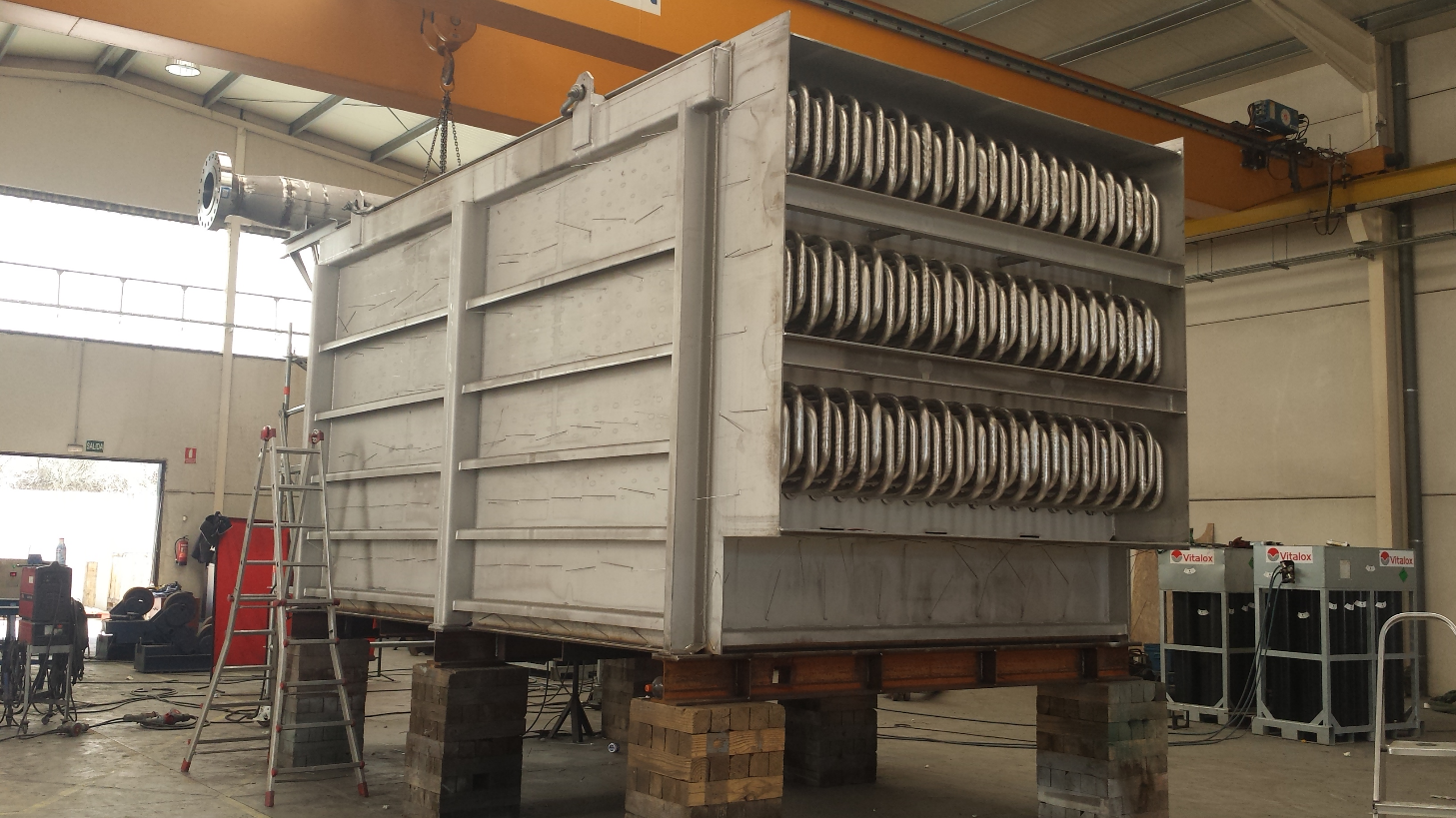
At AITESA, we design superheaters for WHRB and HRSG boilers in demanding industrial applications, tailoring the geometry, materials, and steam circuit configuration to the specific requirements of each project.
This approach is based on a fundamental principle: the superheater cannot be treated as an isolated component. Its performance depends on its integration with the boiler as a whole, the behavior of the flue gases, steam demand, the control systems, and the plant’s actual operating conditions.
When a facility requires superheated steam, or when an existing boiler has limitations in terms of temperature, availability, or service life, the analysis should begin with the actual process conditions and the plant’s operational objectives.
AITESA can analyze the case, review the operating conditions, and develop a solution tailored to the level of overheating, the thermal environment, and the project’s reliability requirements.
You may also be interested in:
Talk to an expert
Aitesa has more than 40 years of experience designing and supplying heat recovery boilers.


