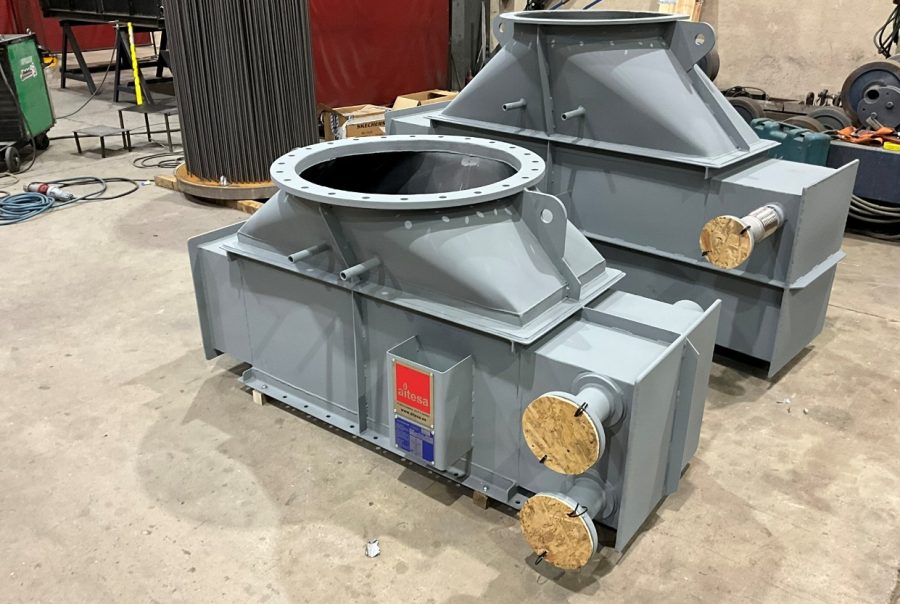
How to estimate fuel savings with an industrial economiser
By AITESA

An industrial boiler can operate correctly while still discharging a significant amount of recoverable energy through its flue. Recovering some of this heat with an economiser reduces the energy that must be supplied by the fuel and, consequently, operating costs.
However, a high flue gas temperature alone is not enough to quantify the savings. Before considering an investment, it is necessary to establish how much heat can be recovered, whether a suitable stream is available to absorb it, how many hours this opportunity exists and what constraints apply to the installation.
The assessment must distinguish three quantities: the heat available in the flue gases, the useful heat that can actually be recovered, and the fuel consumption that can be avoided. These are not equivalent, and treating them as such can lead to unrepresentative savings forecasts.
For improvements to existing installations, this initial estimate helps determine whether the potential identified warrants proceeding to an engineering and equipment sizing study.
What information is needed to estimate fuel savings?
An economiser recovers some of the energy in the flue gases before they are discharged through the stack. In a steam boiler, this energy is normally used to preheat boiler feedwater, reducing the heat input subsequently required to produce steam.
To estimate the potential savings, the operating conditions on both sides of the heat exchanger must be known.
| Required information | Purpose in the calculation |
|---|---|
| Flue gas flow rate | Determine the available thermal power |
| Flue gas temperature at the boiler outlet | Establish the initial temperature level |
| Flue gas composition and fuel type | Assess thermal properties and cooling limits |
| Boiler feedwater flow rate | Determine the capacity to absorb heat |
| Feedwater temperature and pressure | Check the permissible temperature rise |
| Steam production and boiler load | Relate savings to actual operating conditions |
| Annual operating hours and load profile | Calculate the heat recovered over the year |
| Reference boiler efficiency | Estimate the fuel consumption avoided |
| Unit energy cost of the fuel | Convert energy savings into financial savings |
Wherever possible, calculations should be based on operating records rather than nominal design values alone.
A boiler may operate for many hours each year below its maximum load. Under these conditions, the flue gas flow rate, temperatures and feedwater demand may vary, changing the amount of heat recovered compared with the nominal operating point.
An estimate based solely on full-load conditions may therefore overstate annual savings.

1. Calculate the recoverable heat in the flue gases
The first step is to determine the thermal power that could be extracted from the gases.
For an initial approximation of the sensible heat recovered, the following expression can be used:
Q̇g ≈ ṁg × cp,g × (Tg,in − Tg,out)
Where:
Q̇g: recovered thermal power, in kW.
ṁg: flue gas mass flow rate, in kg/s.
cp,g: mean specific heat capacity of the flue gases, in kJ/(kg·K).
Tg,in and Tg,out: flue gas temperatures at the economiser inlet and outlet, in °C.
This expression estimates the energy associated with a given reduction in flue gas temperature. In practice, however, the main challenge is often not applying the formula, but determining the lowest temperature to which the gases can safely be cooled.
The fuel and flue gas composition affect the risk of low-temperature condensation and corrosion. In particular, where sulphur compounds are present or conventional fossil fuels are burned, the acid dew point must be assessed.
For natural gas-fired boilers with very low sulphur content, the cooling limit is generally governed mainly by the need to avoid condensation of water vapour from the flue gases on heat-transfer surfaces (the water dew point), thereby protecting the materials.
Consequently, the temperature drop adopted for a preliminary estimate must be compatible with the process and equipment constraints. It cannot be selected solely to maximise the calculated savings.
2. Check how much heat the feedwater can absorb
Heat available in the flue gases can only be used if there is a stream capable of receiving it.
For a steam boiler, the thermal power absorbed by the feedwater can be approximated by:
Q̇w ≈ ṁw × cp,w × (Tw,out − Tw,in)
Here, ṁw is the water mass flow rate, cp,w is its mean specific heat capacity, and Tw,in and Tw,out are its inlet and outlet temperatures.
This balance indicates the feedwater temperature rise corresponding to the recovered thermal power.
The relationship between the two sides is fundamental: under steady-state conditions, and neglecting heat losses to the surroundings, the heat released by the flue gases should approximately equal the heat absorbed by the water.
However, satisfying the energy balance alone does not guarantee that the solution is feasible.
The temperature differences available throughout the heat exchanger, the required heat-transfer area, pressure drops and the pressure conditions in the water circuit must also be checked.
In particular, the temperature rise must not cause unintended vapourisation within the economiser. The assessment should consider pressure and temperature under all relevant operating regimes, especially at part load.
In other applications, including certain thermal oil systems, the receiving stream and its properties will differ. The energy-balance method remains valid, but the data and limits must correspond to the actual fluid.
3. Convert recovered heat into fuel consumption avoided
Once the thermal power that can actually be recovered has been established, the reduction in fuel consumption can be estimated.
As a preliminary approximation, where the recovered heat replaces energy previously supplied by combustion, the following relationship can be used:
Efuel saved ≈ Euseful heat recovered / ηref
Here, ηref is the reference energy efficiency adopted for generating that heat, using a consistent basis of calculation.
The relationship provides an order-of-magnitude estimate, but an important qualification applies: boiler efficiency and recovered energy are not entirely independent variables.
As fuel consumption falls, flue gas flow rate, gas temperatures and heat-transfer conditions may also change. The final estimate must therefore be based on a consistent energy balance for the installation before and after fitting the economiser, while maintaining the same useful output.
At this preliminary stage, the expression is suitable for assessing the potential and deciding whether to proceed with a more detailed thermal and hydraulic calculation.
Worked example: estimating savings for an industrial boiler
Consider an existing natural gas-fired steam boiler. A non-condensing economiser is being considered to recover some of the heat in the flue gases and preheat the boiler feedwater.
The following figures are illustrative assumptions, not data from a project delivered by AITESA.
Initial conditions
| Parameter | Assumed value |
|---|---|
| Flue gas mass flow rate | 6 kg/s |
| Flue gas inlet temperature | 225 °C |
| Estimated flue gas outlet temperature | 175 °C |
| Mean specific heat capacity of flue gases | 1.10 kJ/(kg·K) |
| Boiler feedwater mass flow rate | 5 kg/s |
| Initial feedwater temperature | 105 °C |
| Mean specific heat capacity of water | 4.20 kJ/(kg·K) |
| Equivalent annual hours at these conditions | 6,000 h |
| Reference energy efficiency | 88% |
| Assumed fuel energy price | €0.05/kWh, on a net calorific value (NCV) basis |
The example assumes that the temperatures, pressures and heat-transfer conditions are feasible. The selected flue gas outlet temperature is not a universal design limit.
Step 1. Calculate the recovered thermal power
The flue gas temperature drop is 50 °C:
Q̇g = 6 × 1.10 × (225 − 175)
Q̇g = 330 kW
Under the assumed operating conditions, the economiser would recover approximately 330 kW of thermal power.
Step 2. Check the feedwater temperature rise
With a feedwater flow rate of 5 kg/s:
330 = 5 × 4.20 × (Tw,out − 105)
Solving for the outlet temperature:
Tw,out ≈ 120.7 °C
The water temperature would therefore rise from approximately 105 °C to 121 °C.
The energy balance between flue gases and water is consistent. Nevertheless, the heat exchanger design would still need to confirm that the available temperature differences, heat-transfer area and hydraulic conditions are adequate.
Step 3. Estimate the energy recovered over the year
Assuming 6,000 equivalent operating hours a year at these conditions:
Erecovered = 330 kW × 6,000 h
Erecovered = 1,980,000 kWh/year
Annual heat recovery would be approximately 1.98 GWh of thermal energy.
Step 4. Estimate the fuel consumption avoided
Using the reference efficiency of 88%:
Efuel saved ≈ 1,980,000 / 0.88
Efuel saved ≈ 2,250,000 kWh/year
At an assumed fuel price of €0.05/kWh:
Gross savings ≈ 2,250,000 × 0.05
Gross savings ≈ €112,500/year
This is a preliminary financial estimate, not a guarantee of savings. It assumes that the calculated useful heat can be recovered for the stated operating hours and can displace the expected fuel energy input.
How operating hours and fuel prices affect savings
The financial savings achieved by an economiser depend on its heat recovery capacity, the actual operating regime and the cost of fuel.
In the worked example, keeping recovered thermal power at 330 kW and reference efficiency at 88%, the result varies substantially with equivalent operating hours and energy price.
| Equivalent annual hours | Gross savings at €0.04/kWh | Gross savings at €0.06/kWh |
|---|---|---|
| 4,000 h | €60,000/year | €90,000/year |
| 6,000 h | €90,000/year | €135,000/year |
| 8,000 h | €120,000/year | €180,000/year |
Illustrative sensitivity table. Recovered thermal power is held constant to isolate the effect of operating hours and fuel price. In an actual project, heat recovery must be calculated for the different load conditions.
This variation explains why an economiser may deliver attractive returns in a continuously operated plant while being less attractive in another installation with fewer running hours.
It also highlights why nominal equipment performance must not be extrapolated automatically across the whole year.
From gross savings to return on investment
The fuel consumption avoided is the principal financial benefit in many economiser projects, but it is not the only factor to consider when deciding on an investment.
Net savings should account for any additional operating and maintenance costs. These may include higher electricity consumption due to increased pressure drops, cleaning requirements and scheduled maintenance.
The investment should also cover the full project scope, not just the cost of manufacturing the economiser.
For an existing plant, new ductwork, pipework, supports and instrumentation may be required, together with control system modifications and installation work during a planned shutdown.
A simple payback period can be used for a preliminary assessment:
Simple payback = Total investment / Annual net savings
Continuing with the hypothetical example, assume a total investment of €320,000 and additional annual operating costs of €5,000:
Net savings = €112,500 − €5,000 = €107,500/year
Simple payback = €320,000 / €107,500 ≈ 3 years
This calculation does not represent a typical AITESA payback period or a benchmark that can be applied to other installations.
Its purpose is to show how energy savings should be linked to the actual economics of a project.
A more detailed investment assessment should also examine sensitivity to fuel prices, potential production changes, shutdown costs, maintenance and the expected service life of the equipment.
In addition, a final investment appraisal should consider any available grants, tax relief or regional and national incentives for industrial energy efficiency projects, as these may significantly shorten the effective payback period.
What can reduce the savings initially estimated?
The preliminary calculation must be checked against the conditions under which heat recovery will actually take place during operation.
Part-load operation. A reduction in load changes flue gas flow, temperatures and heat-transfer capacity. Full-load recovery potential cannot be applied to every operating hour without adjustment.
Minimum permissible flue gas temperature. Fuel composition, tube wall temperatures and possible condensation and corrosion may limit how far the gases can be cooled.
Capacity of the receiving circuit. If the feedwater flow rate or heat demand is insufficient, not all the potentially available heat in the flue gases can be recovered.
Pressure drops. Adding an economiser increases resistance in the flue gas and water circuits. The effect on fans, pumps and operating conditions must be checked.
Fouling and deterioration. Deposits on heat-transfer surfaces increase thermal resistance and may reduce heat recovery compared with the initial design conditions.
These factors do not necessarily make installing an economiser unviable. They mean that the savings estimate must be supported by a design able to maintain performance under actual operating conditions.
Estimating savings when retrofitting an economiser to an existing boiler
In retrofit projects, the potential for heat recovery must be assessed alongside the practical constraints of integration.
A boiler house may offer favourable energy recovery conditions but little space to reroute flue gases or accommodate new equipment.
Before an investment is taken forward, available space, supporting structures, existing connections, the additional pressure drop and the fan operating margin must be assessed. Integration with feedwater pumps, the control system and operating procedures must also be reviewed.
Where several boilers are installed, the assessment should consider how steam production is distributed between units and which boilers account for most operating hours. Applying the same solution to every unit is not always necessary or economically optimal.
Ease of installation and the available shutdown window also affect project cost and risk.
For this reason, the economiser offering the greatest theoretical heat recovery is not necessarily the option with the best financial return.
The objective is to identify a configuration that delivers reliable energy recovery, is compatible with the existing plant and can be installed at a cost proportionate to the expected savings.

What information is needed for an initial project assessment?
A detailed engineering package is not required to begin assessing a potential saving.
An initial enquiry can start with basic information about the boiler, the fuel used, steam production, flue gas temperature and operating hours.
Where more data is available — including flue gas and water flow rates, flue gas composition, feedwater temperatures, historical fuel consumption or engineering drawings — the estimate can be refined.
It is also helpful to explain what has prompted the assessment: a need to reduce fuel use, elevated stack temperatures, a capacity increase, replacement of ageing equipment or the evaluation of energy efficiency improvements within an existing installation.
This information helps establish what further data the engineering team will need to determine recoverable heat, design constraints and preliminary project feasibility.
Heat recovery guided by operational performance and economics
The return from an economiser does not depend solely on how much it lowers the flue gas temperature.
It depends on the energy that can actually be transferred, the hours over which that recovery is useful and the resulting ability to reduce fuel consumption without compromising plant operation or availability.
A sound assessment must therefore connect the heat balance with the load profile, design limitations and scope of integration.
This enables a heat recovery opportunity identified at a plant to be developed into a technically grounded and economically assessable energy efficiency proposal.
Talk to an expert
Is your plant considering how to reduce fuel consumption in an industrial boiler or make use of heat currently discharged through the stack?
The AITESA contact form provides a way to describe the installation, its operating concerns and the savings objectives. Our technical team will review the enquiry to understand the requirements and consider which improvements may be appropriate.
Find out more about AITESA’s industrial boiler economisers.